 Rifnote
Loading your desk
Rifnote
Loading your desk


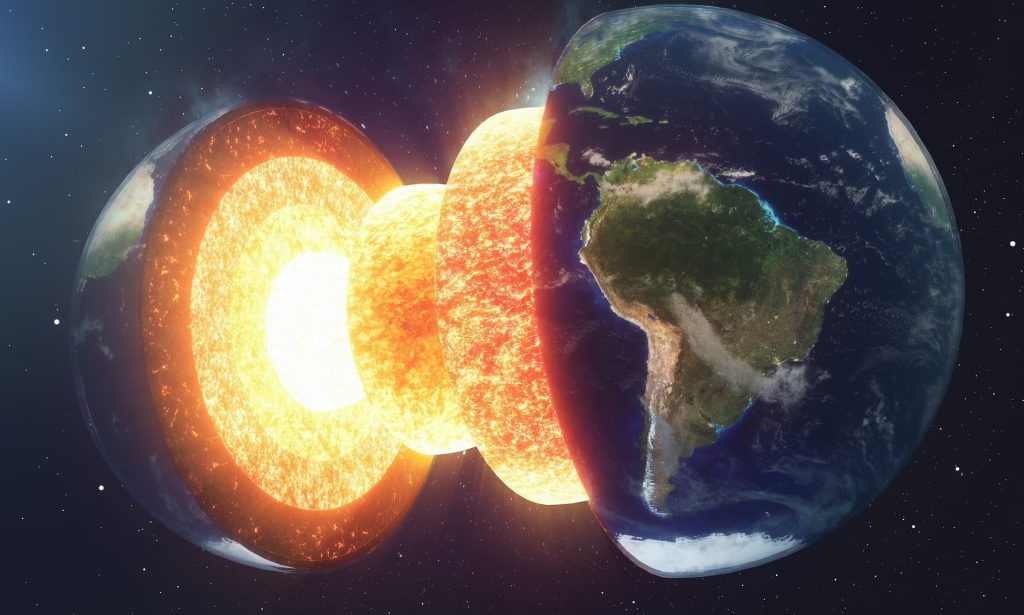
Gravity from Earth’s inner core may be nudging the length of our days
Scientists say a gravitational tug between Earth’s solid inner core and its rocky mantle has been subtly changing the length of a day for decades, making it a few milliseconds longer or shorter, according to the Daily Mail.
The changes are far too small to notice, but they matter for GPS navigation and global timekeeping, which rely on precise measurements of Earth’s rotation. University of Alberta physicists Huifeng Zhang and Mathieu Dumberry analyzed records from 1964 to 2019 and published their findings in Nature on September 23.
The inner core, a hot ball made mostly of iron and nickel, is not perfectly round. As it rotates, its gravity interacts with uneven masses in the mantle. This creates a “gravitational torque” that can slightly speed up or slow the mantle. The researchers linked the effect to a roughly 70-year pattern of change in Earth’s rotation.
The study also suggests the inner core can slowly change shape over years while staying solid. A rigid core produced results with the wrong timing, while a deformable one matched observed day-length shifts more closely. The adjustment likely takes eight to 10 years.
To isolate the effect, the team removed the influence of winds, oceans and the moon’s braking effect. Magnetic forces and pressure at the core-mantle boundary produced patterns opposite to those recorded, while gravity fit far better. The calculations also hint at an iron-rich, electrically conducting layer about 1.2 miles thick near the mantle’s base, though it was not directly sampled.
The authors cautioned that the 70-year pattern may not repeat, and some estimates shifted by up to 30 percent depending on the flow models used. Shorter fluctuations over 10 to 30 years remain unexplained, and better models are needed.