 Rifnote
Loading your desk
Rifnote
Loading your desk


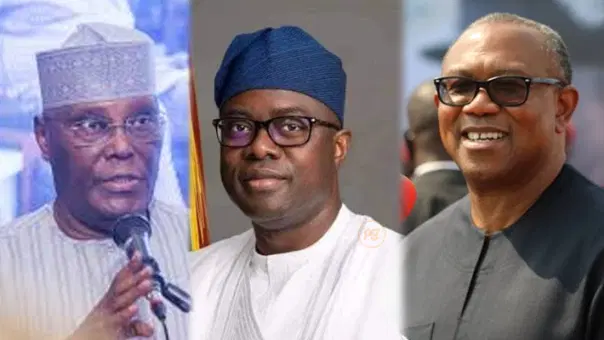
Three egos, one ticket: The coalition’s 2027 math problem
Step down or stand by: The choice facing Atiku, Obi and Makinde
There is a peculiar Nigerian tragedy replaying itself in real time, and it has nothing to do with the ruling party. It is the opposition, once again, doing the APC’s work for it — for free.
With the January 16, 2027 election drawing closer, and INEC set to publish its final list of candidates on September 12, Nigeria’s opposition finds itself exactly where it was in 2023: fragmented, self-important, and one bad arithmetic lesson away from handing President Bola Tinubu a second term he arguably has not earned. Tinubu polled just under 8.8 million votes in 2023. Atiku Abubakar took close to 7 million. Peter Obi took just over 6 million. Add them together, and the opposition commanded roughly 13 million votes to Tinubu’s 8.8 million — and still lost, because those votes were never united behind one name. That is not a moral failing. It is arithmetic, plain and brutal, and according to a report by BusinessDay, even the candidates know it. Former Cross River governor and Peoples Redemption Party candidate Donald Duke put it bluntly: a divided opposition will hand Tinubu victory, and he — unlike his more famous rivals — says he is ready to step down for a genuine consensus candidate.
That offer alone should embarrass the field. Duke has no illusions about winning outright. He has looked at the numbers, looked at the incumbency machinery arrayed against the opposition — the police, the governors, the federal purse — and concluded that ego is a luxury the opposition cannot afford. Compare that to Atiku, Obi, and Seyi Makinde, three men who have each, at various points, been told plainly that unity is the only path to defeating an incumbent president in Nigeria, and who have each, in various ways, responded with a version of: let the other man step down first.
The candidates: three men, zero sacrifices
Start with Atiku. His camp’s argument, relayed to The Punch, is that he “thought about” the coalition idea years ago, built the ADC around it, and is therefore entitled to the ticket while everyone else — implicitly including Obi, who left the original coalition talks to join the NDC — should fall in line behind him. It’s a tidy story, except it ignores the inconvenient fact that Atiku has lost every previous presidential bid he has mounted, going back decades. At some point, seniority in the queue stops being a credential and starts being a warning sign.
Then there is Obi, whose camp argues the presidency is “the turn of the South” and that Atiku, at nearly 80 by 2031, should simply wait his turn behind a one-term Obi presidency. It is a plausible-sounding argument until you remember that Obi made an identical promise in 2023 — to serve one term — with no binding mechanism behind it, and that promises made on the campaign trail in Nigeria have a long and undistinguished history of evaporating the moment power is secured. Ask Nigerians how many “restructuring” and “one-term” pledges have survived contact with Aso Rock.
And then there is Makinde, whose party insists he is “in the race to win” even as it simultaneously courts consensus-candidate status — a position that amounts to keeping every door open while committing to none of them. It is the political equivalent of wanting to be picked as team captain while refusing to say whether you’re even willing to be on the team.
None of these men, according to reporting by The Punch and Leadership, has agreed to step aside. All three skipped the actual G-100 summit in Abuja in person — a detail their aides insist means nothing, but which analysts like Professor Elijah Agbaje and Professor Major Adeyi read, more plausibly, as three men who do not trust each other enough to sit in the same room while their proxies discuss which of them should quit the race.
The G-100: a name that undersells its own stakes
Then there is the matter of the coalition’s name itself — the “G-100.” It sounds less like a serious political vehicle capable of unseating an incumbent president and more like a WhatsApp group chat or a vague corporate strategy retreat. Compare it to the ADC’s 2013–2015 predecessor coalition, which had a clear, singular identity and produced Muhammadu Buhari as a genuinely agreed consensus candidate — the only time in Nigeria’s Fourth Republic an opposition alliance has actually defeated a sitting president. The G-100, by contrast, has produced committees, working groups, a “Transition Charter,” a “Government of National Competence,” and, as of this writing, zero candidates willing to withdraw. It has all the architecture of seriousness and none of the substance. A coalition should be judged by what it forces its members to give up, not by how many acronymed subcommittees it can spin off. On that test, the G-100 has so far asked nothing of anyone and gotten exactly what it asked for: nothing.
What actually needs to happen
If Nigeria’s opposition is serious about 2027, it needs less summitry and more spine. It needs one of Atiku, Obi, or Makinde to do what Donald Duke has already volunteered to do — put the country ahead of personal ambition and step aside for whichever candidate genuinely commands the broadest coalition of 2023’s 13 million opposition votes. Anything short of that is theatre, and Nigerians have seen this play before. The APC did not defeat Goodluck Jonathan in 2015 by holding summits about summits. It did it by making a hard, unsentimental choice about who would carry the ticket, and then closing ranks behind it.
Until Atiku, Obi, or Makinde is willing to make that same sacrifice, the G-100’s fine-sounding transition charters are just paperwork — and Tinubu, watching from Europe or wherever else he happens to be this week, has every reason to relax.
POPULAR
- 2027: Aregbesola slams Tinubu’s “emi lokan” as despotism, urges Nigerians to stop assault on democracy
- Wike, Fubara meet behind closed doors at governor’s Port Harcourt home
- Christa Pike is conscious and speaking…
- Ondo monarch shot dead during fellow traditional ruler’s burial
- Ronaldo apologises to Portugal teammates, accuses Jesus of broken promises